Blog Reflection Quarter 4

Over this past year, I think I have evolved as a blogger. Fourth quarter, I have blogged about topics that relate to our class discussions and about my junior theme experience. Blogging has become not an assignment (as it started off as first quarter), but a way for me to think critically and reflect on our society and discussions we have in class, and stay updated on current events. I definitely feel more comfortable blogging now as opposed to first quarter.
My favorite blog post this quarter is "Facebook...for first graders" (5/21). Although I did not have as many blogs fourth quarter as previous quarters, I really liked this blog both because it pertains to the discussions we've had in class on the media and technological changes in our society, and because I actually felt very strongly about the topic. I think the idea of social networking for young children is very relevant and a little scary.
Overall, I have really enjoyed learning how to blog and become comfortable blogging :)

Thursday, November 19, 2009

The Right...to hang laundry?


"U.S. Residents Fight for the Right to Hang Laundry" ?? This article heading completely surprised me when I stumbled across it this morning on Yahoo. Perhaps because I never thought of hanging laundry as a right that could be taken away. But, in many towns in Pennsylvania and across the U.S., this right is being opposed. Carin Froehlich hangs her laundry every day on a clothesline between her trees in her backyard. She does this to save energy and save money. However, neighbors have sent her anonymous letters telling her that her yard looks like "trailer trash" and they don't want to see her "unmentionables", even though she hang
s her underwear inside. According to the article, many towns have passed "No haning rules" because, "The consensus in most communities is that people don't want to see everybody else's laundry." Also passing these rules are housing associations such as condominiums and townhouses that make up 20 percent of the population.

Personally, I think that this is an insignificant battle to be fighting. We live in an age where most people are very aware of the environment and there is immense pressure I think, on our generation, to help save our planet. Hanging laundry to dry reduces the greenhouse gases and energy consumption, so why ban this eco-friendly practice? Carin Froehlich brings up a good point: "'If my husband has a right to have guns in the house, I have a right to hang laundry,'" she says. Although I don't believe that people should have the right to possess arms, I firmly believe that this right should not be taken away from American citizens. I think that hanging clothes outside is a harmless act, especially if undergarments are kept inside, plus it has huge benefits. What does it say about our nation if we care more about what is in our neighbors backyards (appearances), than the health of our planet?

Picture from: http://imagecache2.allposters.com/images/STFPOD/859022.jpg

Sunday, November 8, 2009

Cruel and Unusual Punishment?


In light of the civil liberties discussions we have been having in class, I read an interesting article, "Weighing Life in Prison For Youths Who Didn't Kill", that touches upon this subject. In Florida, 77 people are serving a life in prison with no opportunity for parole because of crimes they committed as juveniles, none of them murder. Two of these prisoners (one raped a woman and the other committed an armed burglary) are going to appeal in court on Monday, saying that they should not be sentenced to die in prison for a crime other than a homicide because the Eight Amendment bans cruel and unusual punishment. Judges and state representatives are divided over the issue. Some see locking them up without hope for the future as barbaric, but others see teens as having the ability to determine basic right verse wrong, and in those cases, they should be punished and treated as adults. Many people also feel that because Florida is a tourist state and a sought out place for retirement, it needs to be safe and secure.

I think that punishing these people for life for crimes they committed as teens is not appropriate. As people who believe that juveniles should not be executed argue, "people under 18 are immature, irresponsible, susceptible to peer pressure and often capable of change.". The key phrase I think here is "capable of change". I agree completely that teenagers whether 13 or 17 should know that it is wrong to rape someone, wrong to commit a robbery, and those people deserve to spend a long chunk of time in prison. But, I do believe that with therapy and help, these teens can change, their brains will develop more, and they should have another shot at life. It's unfair to punish them away for ever because of a mistake (in these cases huge mistakes), that they made. I think that regarding the 8th amendment, it is cruel to keep them in prison for life, without any hope for the future. Disregarding the death penalty, the Supreme court usually allows states to decided how to punish each crime. Yet I think that this situation is unconstitutional.

Do you think that this is a situation in which one's constitutional rights are not being regarded? Or is this punishment just and constitutional?

picture: http://afghanistan.foreignpolicyblogs.com/files/2009/07/prison.jpg

Monday, November 2, 2009

War as an Equalizer

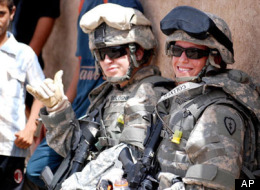
I read an interesting article about women who fight in the military, particularly about a women named Vivienne Pacquette who has been employed in the army for more than 20 years and spent 2 of those years in Iraq. The main focus of the article was post-traumatic stress disorder, (click here for more information on p.t.s.d.) which results from the trauma that the soldiers deal with while employed. Post-traumatic stress disorder can distorts personalities, lead to trouble sleeping, paranoia, and isolation. The article says that never before has there been so many women "paralyzed by the psychological scars of combat", and this is due to a historic shift in that the military has allowed women to take part in ground combat, positions previously barred from women.

Experts who have been studying these women acknowledge that female soldiers have been dealing with the stresses that come from fighting in ground combat just as well as the males are, and that "Psychologically, it seems, they are emerging as equals." But, different circumstances upon returning home lead to differences in coping between males and females. Regardless, Vivienne Pacquette, along with many other women, believe that war has been an equalizer. Instead of women being seen as weak, they are now fighting side by side men in Iraq, facing road side bombs, mortar attacks, and shootings, together.

So does this mean that we need war in order to bring equality between males and females? I think that by allowing men and women to fight side by side together in a war, they are creating equality in the war zone, because neither gender has a direct advantage: both are facing the same dangers and being effected mentally almost the same. Without war, I think that many people would still see women as physically inferior to men. But I also think that many people in society will still view women as less than when they return home from war because of the stereotypical role they are cast into. Indeed, the article says, "after completing important jobs in the war, women...smack up against old-fashioned ignorance: male veterans and friends who do not recognize them as "real soldiers";... and a society that expects them to be feminine nurturers, not the nurtured." People are not used to women in the role of a soldier, but I think that as more and more women do take on this role, it will help women to escape from their stereotypical role in society.

(picture from http://images.huffingtonpost.com/gen/23640/thumbs/s-FEMALE-large.jpg)

Wednesday, October 21, 2009

The Past, the Present, The Future

"The family you come from isn't as important as the family you're going to have." - Ring Lardner

Everyday walking up to the third floor at school, I see a framed sign with this quote in it. And everyday, it bothers me. It just does not seem right. If anything, the family you come from should be
of equal importance to the family you are going to have - if you do get married and have another family.
The family that you come from is your past, which although it should not define you, it has a huge
impact on you. The bonds you create with your family allow you to learn to trust and love, and being part of a family allows you to be part of a unit. This not only gives a child security, but the opportunity to develop and see how family relationships work so when the time comes for you to start your own family,
you can create the same relationships. Obviously there are all different types of families, some in which the relationships and bonds are not so good, but you can't choose the family that you are born into.
I think this quote does not promote positive ideas - to me, it makes me think that I shouldn't focus on being a part of my family, working to create bonds with my siblings or establish good relationships with my parents because when I'm 25 or 30 or whatever and start a new family, it will be more important.
What's more, the family you have or the family you are going to have - I don't see them as two separate entities. They are connected. When I want to start my own family, I will be expanding my family, the one that has raised me, helped make me who I am, and allowed me to create long lasting relationships. My family started me off on the path I'm now. It is most definitely just as important as my future family.

Tuesday, October 20, 2009

Toxic Parents

I read an extremely interesting article today that dealt with the subject of abusive parents. The article talked about a therapist who has worked with many patients who suffer because of bad relationships they have with their parents. One women's mom was extremely abusive to her daughter over the years, but as her mom was dying, the women still felt like she should go and try to reconcile with her, even though her mom was always awful towards her when she tried to fix their relationship. Another young man was disowned by his parents because he came out as gay to them and they could not support his sexuality due to their religion. Even in an intervention staged by the therapist, the parents could not accept their son for what he was. The author of the article rights, "the assumption that parents are predisposed to love their children unconditionally and protect them from harm is not universally true." Although, I believe that it should be. In this case, the therapist recommended that this man stop trying to reconcile with his parents (after he attempted but did not succeed many times). He did, and eventually was able to overcome his depression, but he never forgot the absence of his parents.

Research shows that humans are hard-wired for bonding, the article says, so breaking this tie with abusive parents can be extremely hard. Furthermore, most abusive relationships are not always all bad. However, research also shows that childhood trauma can be very bad for the brain and can drastically impair adults' brains. Thus, having an abusive parent can be very detrimental to brain, development, and feelings. The therapist concludes that even though it may be severe, sometimes letting go of a parent is the best thing to do.

This article really struck a chord with me; I do not have abusive parents but I do know people who have abusive parents and it does not go without effect on them. But, I think that it is really sad that in the cases presented above, such drastic measures had to be taken. In my mind, parents should be accepting, nurturing, and selfless for their children. What do you think? Is it worth it to continue trying to mend relationships with an abusive parent or is it better to move on and focus on living a happy life? Does it all depend on the relationship, the situation?

Sunday, October 18, 2009

Dealing with Grief

I saw an article from the Chicago Tribune called: After Maya, Officer keeps memory of 4-year old alive with every ticket. The article was about a policeman who sits by an intersection (Belden and Lincoln Park West avenues) everyday, waiting to hand out tickets to people who blow through the intersection. When he does give them a ticket, it has a sticker on it that reads: "REMEMBER MAYA! Maya was killed by a driver who failed to stop at a stop sign & yield to pedestrians in a crosswalk. STOP AT STOP SIGNS! YIELD TO PEOPLE IN CROSSWALKS!"

Steve Shoup, the policeman, still tears up when he talks about the event three years later, a traumatic event that he witnessed. He said he has made it his mission to police Maya's and other intersections to enforce stop signs and yielding to pedestrian violations. Clearly, the his grief over this incident lighted within him a mission to take action and make sure that what happened to Maya does not happen again.

This article got me thinking on how people deal with grief. Understandably, after witnessing that horrific event, Mr. Shoup wants to do everything in his power to prevent it from happening again, even though he wasn't even at fault, nor did he know Maya personally. What factors then determine how we cope with grief? Is it based on our relationship to the person, our conscience, our place in life? I think it's personal for everyone, and people react differently in different situations, but some are probably more healthy than others. I think that what Mr. Shoup does is good for the community, but he shouldn't feel guilty for Maya's death.

Thursday, October 8, 2009

Death of child leads to Sentancing of Couple

I was horrified today when I read an article about an eleven year old girl who died from diabetes recently because her parents refused to seek medical treatment for her, due to their religious beliefs. This lead to the sentencing of her parents to 30 days of jail time every year for 6 years. That's 6 months of jail time total, and 6 months that these parents won't be able to spend with their remaining two children, whom, the court ordered must be taken to the doctor if they are injured or in need of medical attention during these 6 years. What really horrified me though, was that even when the girl was so ill that she couldn't walk or talk, her parents refused to take her to the doctor. Imagine how helpless that girl was in that situation.


According to experts in the article, there have been at least 50 cases in the US since 1982 where children have been denied medical attention because of religious reasons. Lawmakers are trying to introduce legislation to remove religious exemptions for charges of neglect and abuse. I understand everyone has different religious views, and I respect that, but personally, I don't think children should have to suffer because of the religion their family has that they are born into. At 11 years old, how do you know that is what you believe in, anyway? And is it worth losing a child?


Should parents who refuse medical treatment for their children because of religious reasons be punished? And if the child is underage, should the parent still have the right to decide whether or not to seek medical attention?